How portable light, color and water work
Choose a light for dry ground or underwater, learn how far it reaches and find out why a headlamp’s color can disappear.
These guides describe the October 23, 2026 source snapshot. Two different downloads share the 1.3.1 label; neither was confirmed to match this snapshot.
Hold, drop, or wear your light
Supported items give off light when you or a living mob hold them in either hand, and when they are dropped on the ground. A worn, charged headlamp and the Luminous effect also compete to light their holder. Use the 83-rule catalog to look up bundled items, and the headlamp guide for helmet recipes.
Portable light is visual. It does not change world-light data, spawning, crops, AI or F3 light readings. A brighter-looking cave still needs real lighting where gameplay requires it.
Placed item frames, display entities, chests, projectiles and unrelated armor are not scanned as light sources. Being on fire does not by itself create a source. Dropped light ends when the item is picked up, removed, merged away or despawned.
One entity, one winning source
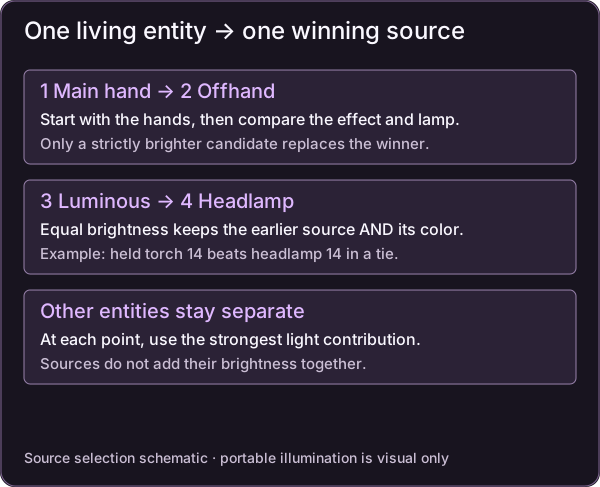
Source-selection diagram. Separate sources use a maximum contribution rather than adding brightness.
For you or a living mob, the game checks these four places in order:
- Main hand.
- Offhand.
- Luminous.
- Headlamp.
Only a brighter light takes over. If two are equally bright, the earlier one in the list keeps its color. Holding a level-14 torch therefore masks a default level-14 headlamp, including its glass color. Emptying that hand can reveal the headlamp’s light again. A level-10 offhand soul torch also wins a tie with Luminous.
Separate entities can each provide light, but brightness at any point uses the maximum contribution, never a sum. A pile of low-level sources will not add up to a single brighter lamp. Quality settings can also limit which sources are selected.
Match the light to the water
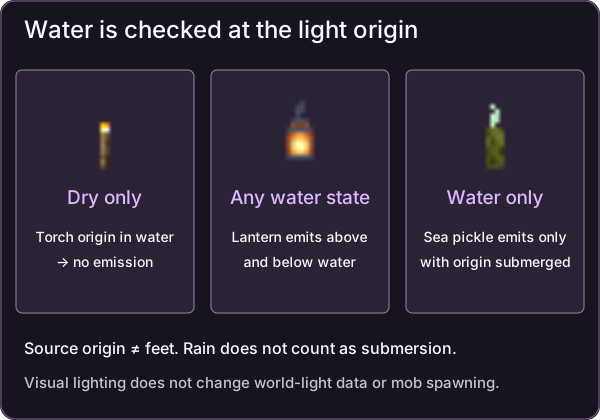
Water-rule illustration using vanilla item artwork. Check the light origin, not the feet; rain does not count. Vanilla artwork © Mojang/Microsoft; original wiki diagram.
Water is checked where the light starts—for example, near your hand or head—not at your feet. The tables call that point the source origin. Rain does not count as submersion.
| Water behavior | When light emits | Examples |
|---|---|---|
| Dry only | Origin is not submerged | Ordinary and soul torches, candles, campfires, furnaces, fire charges |
| Any | Either above or below water | Lanterns, glowstone, lava buckets, redstone torches, sealed headlamps |
| Water only | Origin is submerged | Sea pickles |
Held light starts at roughly 65% of the living entity’s height. A winning headlamp starts at eye height. Dropped light starts 0.15 blocks above the item. These positions explain why a partly submerged entity can behave differently from one whose light origin is fully underwater.
Reach fades with distance
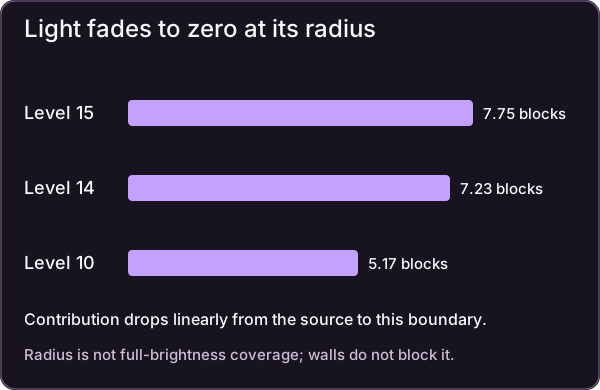
Distance comparison from the source formula; each source grows dimmer before this boundary.
The radius is the distance at which that source’s contribution falls to zero, not a circle of full brightness.
| Source level | Radius in blocks |
|---|---|
| 15 | 7.75 |
| 14 | 7.23 |
| 12 | 6.20 |
| 10 | 5.17 |
| 7 | 3.62 |
| 5 | 2.58 |
| 3 | 1.55 |
| 1 | 0.52 |
Candles can look subtle because their level-3 reach is short. The renderer does not calculate occlusion or shadows, so portable light passes through walls. A small movement trail is a documented limitation.
Understand the color
Portable light adds color to the landscape, players and living mobs where it is brighter than the light already there. Daylight and brighter placed lights retain their appearance. Items drawn in your hands, particles and separately rendered blocks receive extra brightness without that color.
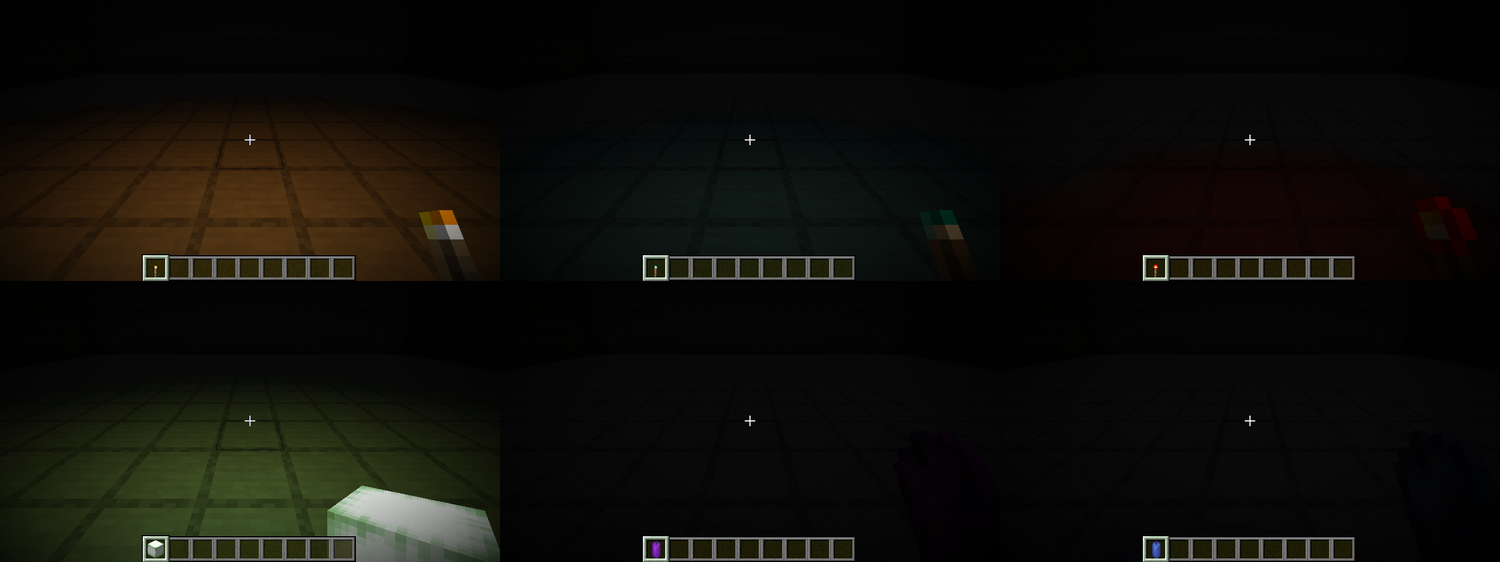
Historical version 1.1 comparison, supplied development record. The candle examples have short reach. It illustrates prior rendering observations, not fresh compatibility testing.
Where lights overlap, their colors blend, with the stronger nearby light having more influence. That color blending does not add brightness. A light standing still can keep an older shade around dusk until the nearby scenery redraws. Shaders can alter, hide or whiten the appearance.
Sources that disappear
Spectators do not give off portable light. Invisible players and mobs are also excluded by default, though the server can change that rule. Distant lights may disappear because of your quality or distance settings, the entities the server sends to your client, or grouping of nearby dropped items.
The setting labeled held sources controls the whole living-source path, including headlamps and Luminous. Disabling it can darken a helmet even when the lamp is charged and on. Settings and troubleshooting explains the checks.
Admin & server owner reference
Sampling formula and implementation
Terrain vertices and living-entity models receive dominant tint. Held-item rendering, particles and block entities receive additional brightness without colored tint. Overlapping source RGB values are averaged with squared light contribution as the weight; brightness itself uses a maximum. Terrain tint is baked into rebuilt sections.
For brightness b, radius R = 7.75 × b / 15 blocks. Inside that radius, the contribution at distance d is b × (1 - d/R); outside it, the contribution is zero. Reported catalog radii are rounded to two decimals.
Source RGB colors are normalized before tinting; dominant-tint strength is 0.85. Packed light combines world and dynamic block brightness by maximum, preserving sky light. No hidden blocks are placed and Minecraft’s light engine is not written to.
The tracker publishes immutable arrays with a 16-block spatial-cell index through a volatile snapshot. Chunk-building workers read that snapshot; sampling avoids allocations per lookup. Old and new source positions queue affected terrain sections for deduplicated, prioritized, budgeted rebuilds.
The four reported client mixins are LevelRendererMixin, EntityRendererMixin, SectionCompilerMixin, and LivingEntityRendererMixin. They cover terrain-related brightness, entity/held-render brightness, chunk geometry tinting and living-model tint in the vanilla rendering path. Their presence does not establish third-party renderer compatibility.
Figure source notes
Historical version 1.1 comparison, supplied project/report page 6. The candle examples have short reach. It illustrates prior rendering observations, not fresh compatibility testing.
Sources & verification
Evidence: pdf-derived. Feature status: implemented-static. Article coverage: ready.
PDF pages 3, 5-6, 11, 19-21 · 01, 03-04, 09, 17-19 · DIL-PDF:S01; DIL-PDF:S03; DIL-PDF:S05; DIL-PDF:S06; DIL-PDF:S07; DIL-PDF:S09; DIL-PDF:S10; DIL-PDF:S14; DIL-PDF:S15
October 23, 2026 source-based 1.3.1 snapshot. Historical checks are attributed; neither same-version JAR is proven equivalent. No new gameplay, build, multiplayer or compatibility verification.
The wiki has not independently playtested report-derived instructions. Your server or modpack settings may change them.